Overview
The Architecture Description Standard (ADS) defines how to write a Solution Architecture Document (SAD) — the single document that describes how a technology solution is designed, built, and operated.
Purpose
Section titled “Purpose”This standard defines the required structure and content for Solution Architecture Documents (SADs). The architectural views and quality attributes within a SAD constitute the High Level Design (HLD) of the solution.
A Solution Architecture Document conforming to this standard serves the following functions:
- Communication — Provides a shared understanding of the solution architecture across all stakeholders
- Governance — Enables the architecture governance process to evaluate the design against quality criteria
- Traceability — Establishes links between design decisions, business requirements, quality attributes, and applicable standards
- Reference — Acts as a living document that accurately describes the current-state architecture
- Evidence — Demonstrates that the solution is well-architected against industry-recognised frameworks
This standard applies to the documentation of any technology solution architecture, regardless of:
- Deployment model — cloud-native, on-premises, hybrid, multi-cloud, or SaaS
- Scale — from single applications to multi-application ecosystems
- Industry — the standard is organisation-agnostic and sector-neutral
- Lifecycle stage — new builds, migrations, modernisations, or incremental changes
The standard is extensible — organisations can add custom sections, map to internal tools and standards, and define governance gates without modifying the core structure. See Organisation Customisation for details.
Audience
Section titled “Audience”This standard is intended for use by:
| Role | Primary Sections |
|---|---|
| Solution Architects | All sections — primary authors of SADs |
| Enterprise Architects | Framework Alignment, Quality Attributes, Governance |
| Security Architects | Section 3.5 (Security View), Quality Attributes |
| Infrastructure Engineers | Section 3.3 (Physical View), Quality Attributes |
| Development Leads | Section 3.1 (Logical View), Section 5 (Lifecycle) |
| Architecture Governance | All sections — as a review and governance framework (e.g., ARB, design authority) |
Document Structure
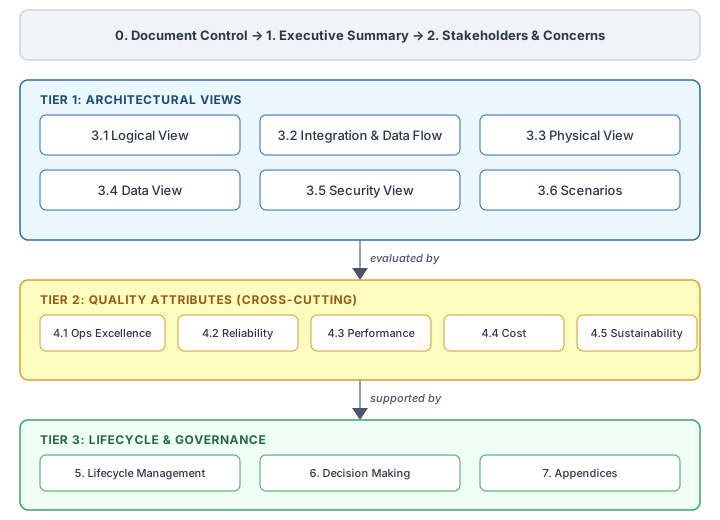
Section titled “Document Structure”A Solution Architecture Document conforming to ADS is organised into three tiers:
Tier 1 — Architectural Views (Sections 3.1 – 3.6)
Section titled “Tier 1 — Architectural Views (Sections 3.1 – 3.6)”The architecture is described through complementary views, each addressing different stakeholder perspectives. These are based on Kruchten’s 4+1 Architectural View Model (a widely-used framework for organising architecture documentation), extended with dedicated Data and Security views.
Together, these views form the High Level Design (HLD) of the solution:
| View | Viewpoint | Primary Stakeholders |
|---|---|---|
| 3.1 Logical View | Application architecture, components, patterns | Architects, Developers |
| 3.2 Integration & Data Flow View | Data flows, integrations, interfaces | Integrators, Architects |
| 3.3 Physical View | Deployment, hosting, networking, environments | Infrastructure, DevOps |
| 3.4 Data View | Data stores, classification, privacy, lifecycle | Data Architects, Compliance |
| 3.5 Security View | IAM, encryption, monitoring, threat model | Security, CISO, Compliance |
| 3.6 Scenarios | Key use cases, architecture decision records | All Stakeholders |
No single view provides a complete description of the architecture. Together, the views provide a holistic picture addressable by all stakeholder concerns.
Tier 2 — Quality Attributes (cross-cutting)
Section titled “Tier 2 — Quality Attributes (cross-cutting)”Evaluate the cross-cutting quality attributes across all architectural views. These are derived from the cloud Well-Architected Frameworks:
| Quality Attribute | Focus |
|---|---|
| 4.1 Operational Excellence | Observability, monitoring, operational procedures |
| 4.2 Reliability & Resilience | DR, scalability, fault tolerance, backup and recovery |
| 4.3 Performance Efficiency | Performance requirements, resource optimisation |
| 4.4 Cost Optimisation | Cost analysis, FinOps practices |
| 4.5 Sustainability | Energy efficiency, carbon impact, resource efficiency |
Tier 3 — Lifecycle & Governance
Section titled “Tier 3 — Lifecycle & Governance”Lifecycle Management (Section 5)
Section titled “Lifecycle Management (Section 5)”Describes how the solution is developed, deployed, operated, and eventually retired — including CI/CD, migration strategy, resourcing, release management, and exit planning.
Decision Making & Governance (Section 6)
Section titled “Decision Making & Governance (Section 6)”Captures the constraints, assumptions, risks, dependencies, and issues that shaped the design. Documents key architecture decisions (ADRs), guardrail exceptions, and compliance traceability.
How the Sections Relate
Section titled “How the Sections Relate”Reading order: A completed SAD tells a story. It begins with the business context and who cares about the solution (Sections 0-2). It then describes the architecture itself through multiple views (Section 3). It evaluates how well the architecture performs against quality attributes (Section 4). It explains how the solution is built, deployed, and operated (Section 5). Finally, it records the decisions, risks, and governance that shaped the design (Section 6).
The diagram below shows how the three tiers work together. Architectural views describe what the solution is. Quality attributes assess how well it performs. Lifecycle and governance cover how it is built, run, and governed.
Documentation Depths
Section titled “Documentation Depths”This standard assigns each section a documentation depth — Minimum (SHALL), Recommended (SHOULD), or Comprehensive (MAY) — that defines when it must be completed. This enables progressive adoption: begin with Minimum for early-stage designs, expand to Comprehensive for critical and regulated systems.
See Conformance and Usage for the full depth table, terminology definitions, and governance gate mapping.
Conformance
Section titled “Conformance”A Solution Architecture Document conforms to this standard when:
- All sections marked Minimum are completed
- The document structure follows the section numbering and hierarchy defined herein
- Architectural views address the stakeholder concerns identified in Section 2
- Quality attributes are evaluated as cross-cutting lenses across the architectural views
- The document is validated against the JSON Schema (ADS Schema v1.0.0) if machine-readable output is required
A document that additionally completes all Recommended sections achieves full conformance.
Ready to Start?
Section titled “Ready to Start?”- Quickstart — create your first SAD in minutes
- Depth Cheat Sheet — see exactly what to fill in at each depth
- Download a template — Word, Markdown, YAML, or JSON
- See completed examples — four worked examples across different project types
Contributing
Section titled “Contributing”ADS is open-source and hosted on GitHub. Contributions are welcome — submit issues, suggest improvements, or open a pull request. The standard content is licensed under CC BY 4.0 and the source code under MIT.